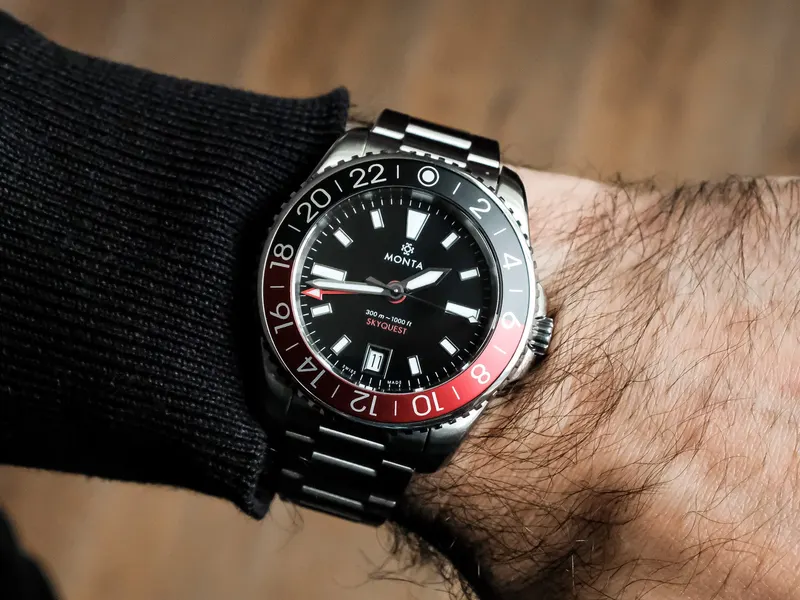
A GMT complication does not tell you how much space a watch will occupy on the wrist. Diameter is a starting point, but lug span, case thickness and the way a bracelet bends can change the result considerably. A useful comparison keeps all of those measurements visible.
Compare complete proportions
The source guide lists the Vaer G2 Meridian at 39 mm across, 46 mm from lug to lug and roughly 10 mm thick. The Nodus Contrail GMT Laguna is wider at 40.5 mm, yet its 46.6 mm lug span remains close, with an 11.8 mm thickness. The Farer Roché II example is listed at 39 mm across and 45 mm from lug to lug.
These figures illustrate why two similar diameters can produce different outlines. They do not establish a universal wrist-size cutoff. Crown projection, end-link shape, clasp bulk and strap stiffness can extend or concentrate the watch’s physical presence beyond the case measurements.
Choose the GMT function deliberately
The G2’s caller-style movement adjusts its 24-hour hand independently. The Contrail’s Miyota 9075 instead supports an independently jumping local-hour hand, commonly called a traveler or flyer GMT. That distinction affects how the watch is set during travel, even when both display a second time zone.
Start with the setting behavior that suits the intended use, then compare full case dimensions and the supplied attachment. Try to see how the bracelet’s first links move, or how the strap curves beneath the lugs. A compact GMT is a coordinated combination of mechanism, case and fit, not simply the smallest diameter in a search result.
Join the conversation
Questions & comments
No comments yet. Have a question or a detail to share?
Sign in to join the conversation