Water resistance is useful information, but it is not a complete score for a watch. A dress watch, a compact field model and a diver solve different problems. Choosing between them becomes easier when the rating is connected to actual use instead of treated as a competition for the largest number.
Keep the reference specific
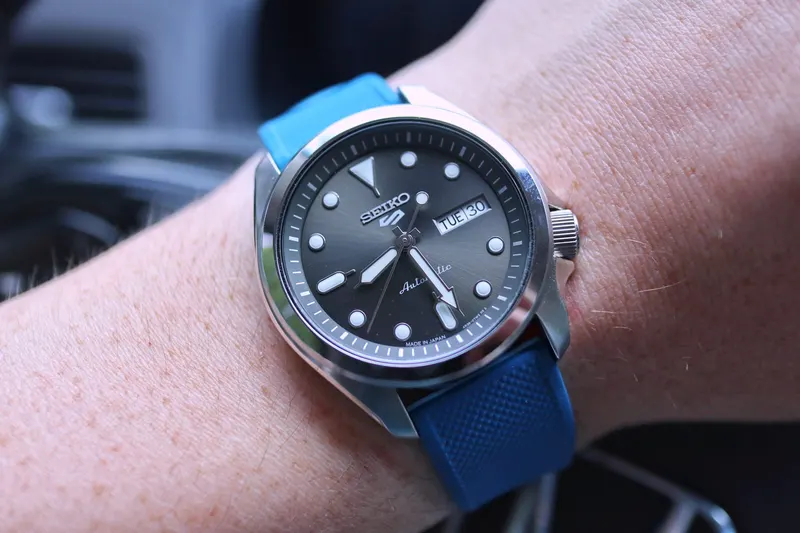
The source discussion includes a Marathon General Purpose Mechanical rated to 30 m, field-watch examples at 50 m and the Seiko SRPE51 at 100 m. These examples differ in size, display, movement and intended role as well as in their water-resistance numbers. The same broad model family can also contain references with different ratings.
A crown’s appearance should not replace the specification. A screw-down crown is a construction detail, while the published rating and operating instructions apply to the whole watch. Age, damage and seal condition also deserve attention when evaluating an individual example, particularly one bought second hand.
Match the watch to the day
If regular water exposure is part of the intended use, confirm the manufacturer’s guidance for that activity and the exact reference. Anecdotes about a watch surviving an online endurance test are not an operating guarantee. A rating should not be interpreted as an invitation to reproduce the number as a real-world depth.
For predominantly dry daily use, other details may become more influential: a readable dial, manageable thickness, suitable strap and controls that are easy to operate. The aim is to understand a watch’s boundaries clearly, then decide whether its complete design suits the routine. A modest rating can be an accepted limitation without making the rest of the watch irrelevant.
Join the conversation
Questions & comments
No comments yet. Have a question or a detail to share?
Sign in to join the conversation